

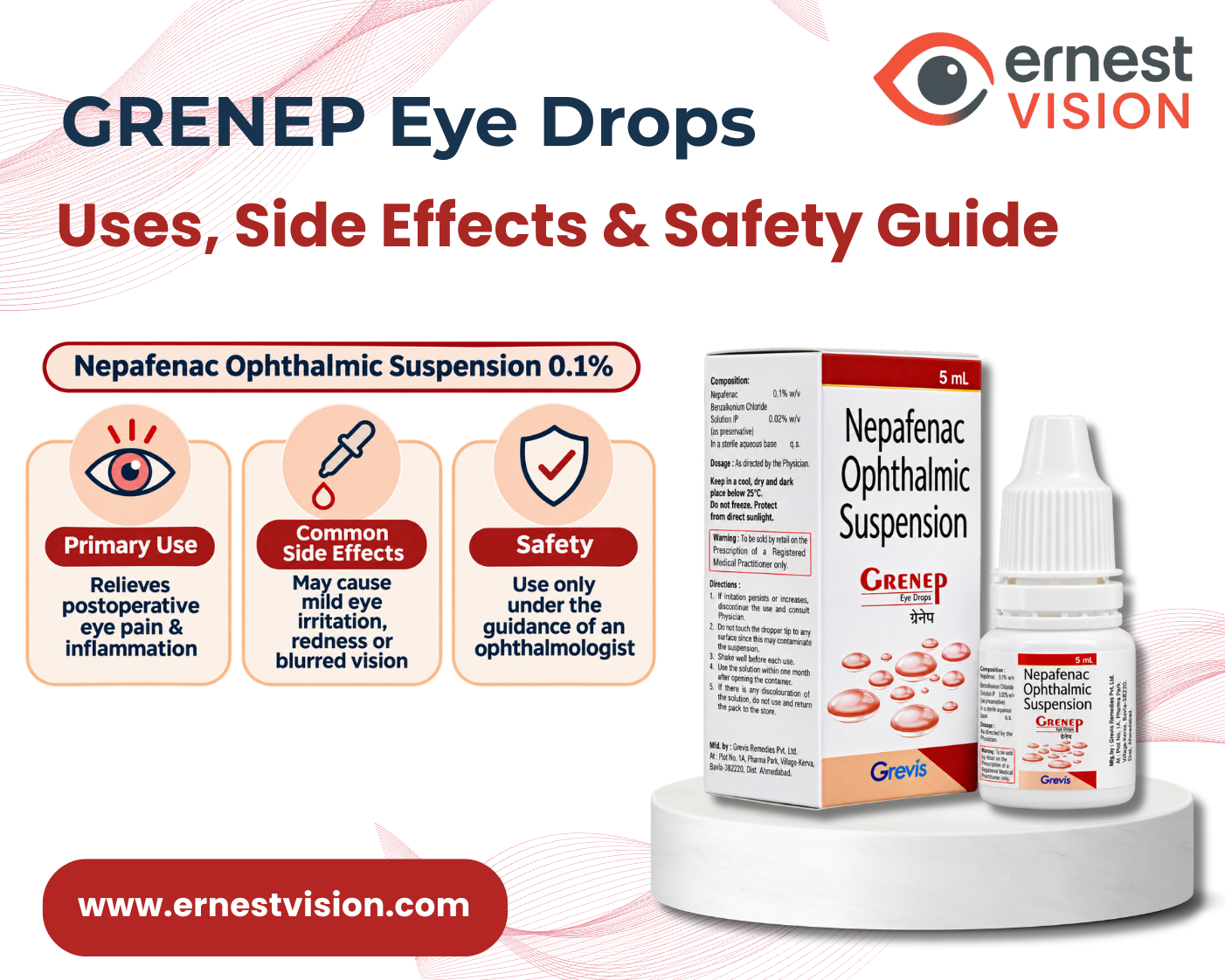
GRENEP Eye Drops 5 ml: Composition, Uses, Benefits & Side Effects
Eye surgery requires careful attention not only during the procedure but also throughout the recovery period. After cataract surgery, some patients experience discomfort, inflammation, or swelling as their eyes begin to heal. Ophthalmologists may prescribe anti-inflammatory eye drops to help manage these symptoms. GRENEP Eye Drops is a Nepafenac 0.1% ophthalmic suspension associated with the management of pain and inflammation following cataract surgery. Unlike ordinary lubricating eye drops, GRENEP contains a non-steroidal anti-inflammatory medicine (NSAID).
What Are GRENEP Eye Drops?
GRENEP Eye Drops is an ophthalmic medicine containing Nepafenac 0.1%. Nepafenac belongs to the non-steroidal anti-inflammatory drug (NSAID) class. Medicines in this category work by reducing the production of substances involved in inflammation and pain. The product is available as an ophthalmic suspension, meaning the active ingredient is dispersed within a liquid formulation. GRENEP should be used only under the guidance of a qualified ophthalmologist. The manufacturer's GRENEP product information identifies Nepafenac 0.1% as its active composition.
GRENEP Eye Drops Composition and Product Specifications
| Product Specification | Details |
|---|---|
| Brand Name | GRENEP |
| Generic Name | Nepafenac |
| Active Ingredient | Nepafenac 0.1% |
| Equivalent Strength | 1 mg/ml |
| Dosage Form | Ophthalmic Suspension |
| Pack Size | 5 ml in the photographed pack |
| Medicine Category | Ophthalmic NSAID |
| Administration Route | Topical ophthalmic |
| Main Treatment Area | Pain and inflammation associated with cataract surgery |
| Prescription Status | Prescription medicine |
Exact packaging, excipients, manufacturer information, expiry date, and storage conditions should always be checked against the supplied product label.
What Are GRENEP Eye Drops Used For?
1. Management of Pain Following Cataract Surgery
Cataract surgery involves removing the cloudy natural lens of the eye and replacing it with an artificial intraocular lens. Although cataract surgery is commonly performed, patients may experience temporary postoperative discomfort. Nepafenac eye drops may be prescribed to help reduce pain associated with surgical inflammation. For more information about the operation itself, read our article on Intraocular Lens (IOL): Types, Uses and Benefits in Cataract Surgery.
2. Reduction of Postoperative Eye Inflammation
Inflammation is part of the body's response to surgical procedures. After cataract surgery, inflammation may contribute to redness, swelling and discomfort. Nepafenac helps control inflammatory activity by inhibiting the production of prostaglandins, which participate in pain and inflammation.
According to MedlinePlus – Nepafenac Ophthalmic, the medicine is used to manage eye pain, redness, and swelling associated with recovery after cataract surgery.
3. Support During Postoperative Eye Care
Ophthalmologists may include an ophthalmic NSAID as one component of a patient's postoperative treatment plan. Different medicines have different roles during recovery. Antibiotic eye drops may be prescribed to address infection-related risks, while anti-inflammatory medicines are used to control inflammation. Nepafenac does not replace an antibiotic when one is required.
How Does Nepafenac 0.1% Work?
Nepafenac is a prodrug, meaning it is converted into another active substance after administration. Inside ocular tissues, Nepafenac is converted to amfenac. Amfenac inhibits cyclooxygenase enzymes involved in prostaglandin production. Prostaglandins are substances that contribute to inflammation and pain. By reducing prostaglandin formation, Nepafenac helps control the inflammatory response associated with cataract surgery.
This mechanism is described in the DailyMed prescribing information for Nepafenac Ophthalmic Suspension 0.1%. The referenced label is for another Nepafenac brand and provides ingredient-level medical information, not product-specific regulatory approval for GRENEP.
Potential Benefits of GRENEP Eye Drops
When appropriately prescribed, a Nepafenac ophthalmic suspension may provide several treatment-related benefits.
Helps Manage Postoperative Discomfort
Nepafenac is used to reduce pain associated with cataract surgery.
Helps Control Inflammatory Symptoms
Its anti-inflammatory activity may help reduce postoperative swelling and redness.
Provides Local Ophthalmic Administration
The medication is administered directly to the eye, allowing local treatment of ocular tissues.
Can Be Part of a Planned Recovery Regimen
An ophthalmologist may prescribe Nepafenac alongside other postoperative medicines when clinically appropriate. These are potential benefits of the active ingredient. Individual outcomes vary, and the medicine does not guarantee faster healing or improved vision.
GRENEP Eye Drops vs Lubricating Eye Drops
Anti-inflammatory eye drops and artificial tears have different purposes.
| Feature | GRENEP (Nepafenac) | Lubricating Eye Drops |
|---|---|---|
| Main purpose | Control postoperative pain and inflammation | Improve ocular surface moisture |
| Medicine category | NSAID | Ocular lubricant |
| Typical use | Selected postoperative treatment plans | Dry-eye discomfort |
| Prescription | Requires medical supervision | Depends on product |
| Main action | Reduces inflammatory mediator production | Improves surface lubrication |
Dry-eye discomfort may develop for several reasons, including reduced tear production or excessive tear evaporation.
For related information, see Why Do Your Eyes Feel Dry in Air Conditioning?.
GRENEP should not be used as an ordinary artificial-tear substitute.
Possible Side Effects of GRENEP Eye Drops
Like other ophthalmic NSAIDs, Nepafenac may cause unwanted effects in some patients.
Reported symptoms associated with Nepafenac treatment or postoperative clinical studies include:
Eye irritation or discomfort
Dry or itchy eyes
Watery eyes
A sticky sensation
Blurred or reduced vision
Foreign-body sensation
Sensitivity to light
Some symptoms reported during studies may also result from cataract surgery itself rather than the medicine.
Serious Eye-Related Risks
Although uncommon, topical ophthalmic NSAIDs can contribute to corneal complications in susceptible patients. Potential problems include keratitis, corneal epithelial damage, and delayed healing. Patients experiencing significant eye pain, worsening redness, unusual light sensitivity, or changes in vision should contact their ophthalmologist promptly. For detailed warnings, refer to the official Nepafenac 0.1% prescribing information on DailyMed.
Important Precautions Before Using GRENEP
Before using Nepafenac ophthalmic suspension, patients should inform their ophthalmologist about existing medical conditions and other medications.
Allergy to NSAIDs: People with known hypersensitivity to napafenec, aspirin, or other NSAIDs may be at increased risk of allergic reactions.
Existing corneal disease: Certain corneal conditions or previous corneal surgery may increase the risk of complications.
Diabetes or rheumatoid arthritis: These conditions may be relevant when evaluating corneal safety and postoperative healing.
Other eye medicines: Using several eye drops together requires an appropriate schedule. Some medicine combinations can increase the risk of side effects.
Pregnancy and breastfeeding: Medical advice is necessary to assess individual risks and benefits.
Contact lenses: Patients recovering from cataract surgery should follow their surgeon's instructions about contact lens use.
How Should GRENEP Ophthalmic Suspension Be Handled?
GRENEP should be used according to the prescribed directions and the specific package instructions.
General handling precautions include:
Wash your hands before administering eye drops.
Check the bottle and expiry date.
Shake the ophthalmic suspension as instructed on the label.
Avoid touching the dropper tip to the eye, eyelid or fingers.
Use only the prescribed amount.
Follow the recommended interval between different ophthalmic medicines.
Replace the cap properly after use.
Do not share the bottle with another person.
The dose, frequency and duration must be determined by the treating ophthalmologist. Do not extend treatment without medical advice.
For general information about ophthalmic products and safe handling, visit Ernest Vision's Frequently Asked Questions.
How Should GRENEP Eye Drops Be Stored?
Storage requirements can vary according to the formulation and packaging.
Patients should:
Follow the storage temperature stated on the original label.
Keep the bottle tightly closed.
Avoid contamination of the dropper.
Keep medicines out of children's reach.
Avoid using the product after its expiry date.
Follow the manufacturer's instructions for the period of use after opening.
The original GRENEP packaging instructions should take priority over general storage recommendations.
Why Is Follow-Up Important After Cataract Surgery?
Cataract surgery is intended to improve vision by replacing the cloudy natural lens with an artificial lens. However, postoperative monitoring remains important. Follow-up examinations allow the ophthalmologist to assess visual recovery, ocular pressure, inflammation, and possible complications. The National Eye Institute's Cataract Surgery Guide explains the importance of prescribed postoperative eye drops and follow-up care. Patients should not assume that their recovery is complete simply because pain or redness has improved.
GRENEP Eye Drops: Information for Healthcare Professionals
For ophthalmologists, hospitals, pharmacies, and procurement teams, reviewing an ophthalmic medicine involves more than identifying the active ingredient.
Important product-related information includes:
Confirmed active pharmaceutical ingredient and concentration
Dosage form and pack size
Manufacturer and marketer identification
Batch number and expiry date
Product registration and applicable regulatory status
Storage and transport requirements
Available technical and quality documentation
The selected product should match the intended clinical requirement and applicable regulatory conditions. Readers interested in broader ophthalmic product categories can explore Ernest Vision's Eye Drops Collection.
Frequently Asked Questions About GRENEP Eye Drops
1. What are GRENEP Eye Drops used for?
GRENEP contains Nepafenac, an ophthalmic NSAID used to manage pain and inflammation associated with cataract surgery when prescribed by an ophthalmologist.
2. What is the composition of GRENEP Eye Drops?
The manufacturer identifies Nepafenac 0.1% as the active composition, equivalent to 1 mg/ml. Excipients should be checked on the current product label.
3. Are GRENEP Eye Drops and Nepafenac Eye Drops the same?
GRENEP is a brand associated with Nepafenac ophthalmic suspension. Other brands may also contain Nepafenac, but formulation strengths and excipients can differ.
4. Can GRENEP Eye Drops be used for ordinary dry eyes?
GRENEP is not an artificial-tear formulation and should not be used as a general dry-eye lubricant.
5. Can Nepafenac Eye Drops cause blurred vision?
Temporary visual disturbance can occur. Persistent or worsening blurred vision requires medical evaluation.
6. Can GRENEP be used with other eye drops?
An ophthalmologist may prescribe multiple eye medicines, but the correct schedule and any interaction risks should be reviewed professionally.
7. Are GRENEP Eye Drops suitable for children?
Suitability depends on the approved product labeling, age and clinical circumstances. The medicine should not be administered to children without specialist advice.
8. Can GRENEP Eye Drops be used for a long period?
Nepafenac is generally used for specific treatment periods, particularly around cataract surgery. Prolonged use without medical supervision can increase the risk of complications.
Conclusion
GRENEP Eye Drops contains Nepafenac 0.1%, a non-steroidal anti-inflammatory medicine used in the management of pain and inflammation associated with cataract surgery. Its mechanism of action helps reduce inflammatory mediator production in ocular tissues. Although Nepafenac may be a useful component of postoperative care, appropriate patient selection, prescription instructions and monitoring are essential. Understanding its composition, intended uses, potential side effects and precautions helps patients and healthcare professionals make informed decisions.