
X Ray View Box: LED Film Viewing & Selection Guide
A radiographic film contains important visual information, but its details can be difficult to examine without suitable lighting. Uneven illumination, unwanted reflections, or poor viewing conditions may affect how clearly the film can be assessed. An X Ray View Box provides an illuminated surface for examining radiographic films. It is used in hospitals, diagnostic centers, and other healthcare facilities where physical X-ray films are reviewed. Modern LED film viewers offer an alternative to traditional fluorescent light boxes. However, choosing a suitable model involves more than comparing brightness or appearance. This guide explains how an LED X Ray View Box works, why illumination quality matters, what to check when selecting equipment, and how to maintain a consistent film-viewing environment.
What Is an X Ray View Box?
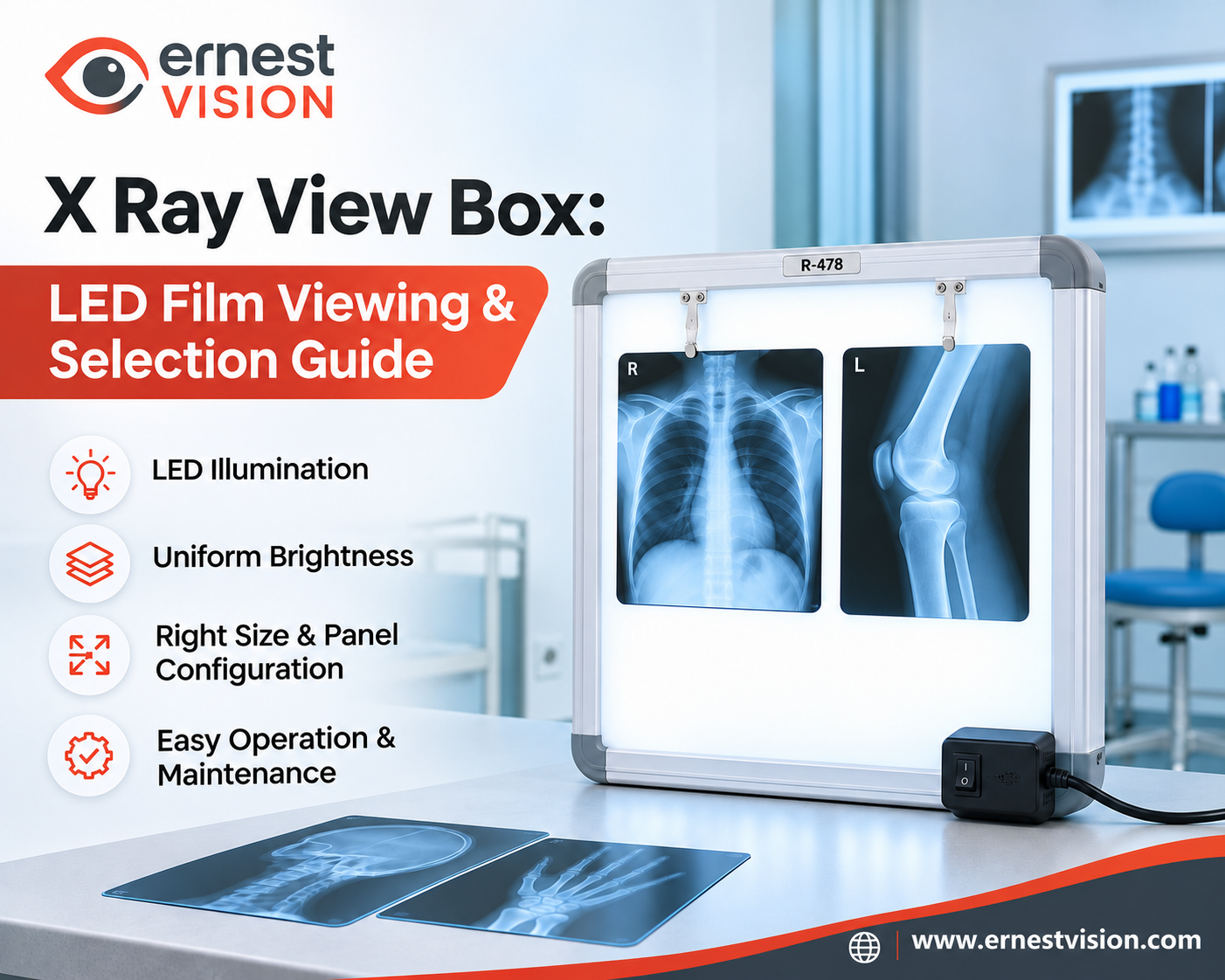
An X Ray View Box, also called an X Ray Film Viewer or radiology light box, is an illuminated panel designed to make the details on radiographic films easier to observe. The viewer is positioned behind a developed or printed radiographic film. Light passes through the film, making differences in optical density visible. Healthcare professionals can then examine the film under suitable viewing conditions. An X Ray View Box is a film-viewing accessory, not an X-ray-generating machine. It does not expose patients to X-rays, capture diagnostic images, or replace the radiology equipment used to create them. For a product example, see the R-478 LED X-Ray View Box listed by Ernest Vision.
How Does an LED X Ray View Box Work?
An LED X Ray View Box uses a light source behind a translucent viewing surface.
The basic viewing process involves three components.
1. LED Illumination
LEDs generate light inside the unit. In a suitably designed viewer, the illumination system distributes this light across the viewing area. Even illumination is important because darker or brighter areas on the viewing surface can interfere with the visual assessment of a radiographic film.
2. Light-Diffusing Panel
The viewing panel spreads the light across the surface. A suitable diffuser helps reduce distracting bright spots and uneven lighting. The effectiveness of the panel depends on the light source, its arrangement, and the overall design of the viewer.
3. Film Placement
The radiographic film is positioned on the illuminated panel, allowing light to pass through it for clearer examination of the image details. The viewer's light passes through the film, allowing its darker and lighter regions to be examined. Some models include film-holding mechanisms, adjustable brightness, or automatic switching. These features depend on the particular equipment design.
Why Does Illumination Quality Matter?
Not all film viewers provide the same lighting performance. The International Atomic Energy Agency (IAEA), in its Handbook of Basic Quality Control Tests for Diagnostic Radiology, identifies uniform illumination and the absence of flickering as important factors when evaluating an X-ray film viewer.
Uniform Brightness
A viewing box should provide reasonably consistent brightness across the area used for film interpretation. Large variations in illumination can make the visual appearance of the same radiographic film change depending on where it is positioned.
Suitable Luminance
Luminance refers to how bright a surface appears when viewed from a specific direction. It is generally expressed in candelas per square metre (cd/m²). A brighter viewer is not automatically better for every application. Appropriate luminance depends on film characteristics, clinical requirements, and viewing conditions.
Low Flicker
Noticeable flickering can distract the viewer and interfere with consistent visual assessment. Lighting stability is therefore an important equipment evaluation factor.
Controlled Surrounding Light
The environment around the viewer matters as well. Excessive room lighting and reflections may reduce the observer's ability to distinguish subtle details. Appropriate ambient lighting and masking of unused illuminated areas can help create better film-viewing conditions.
Where Are X Ray Film Viewers Used?
Radiology Departments
Radiology departments may use film viewers to examine physical X-ray films, review historical records or compare printed images. Film viewers remain relevant wherever hard-copy radiographs are part of the facility's workflow.
Orthopaedic Clinics
Physical radiographs may be reviewed during clinical discussions involving bones, joints and musculoskeletal conditions. The clinician remains responsible for interpreting the images.
Diagnostic Centres
Centres handling printed radiographic films may require viewing boxes for film inspection, discussion and record comparison.
Dental Clinics
Dental professionals who use film-based radiography require suitable conditions for examining dental radiographs. Health Canada's Radiation Protection in Dentistry guidance discusses the importance of viewbox cleanliness, lighting consistency and appropriate viewing conditions.
Teaching and Training Facilities
Medical and radiography training institutions may use film viewers during practical teaching sessions involving radiographic images. The need for a viewer depends on the institution's equipment and teaching methods.
LED vs Traditional Fluorescent X Ray View Boxes
LED and fluorescent viewing boxes serve similar purposes, but their lighting systems differ.
| Feature | LED Film Viewer | Fluorescent Film Viewer |
|---|---|---|
| Light source | Light-emitting diodes | Fluorescent lamps |
| Typical design | May support a slim profile | Often uses a deeper housing |
| Brightness control | Available on selected models | Depends on design |
| Lighting uniformity | Depends on LED and diffuser design | Depends on lamp and diffuser design |
| Maintenance | LED module servicing may be required | Lamp replacement may be required |
| Energy consumption | Depends on model and operating conditions | Depends on lamp and electrical design |
| Film viewing | Suitable when performance requirements are met | Suitable when performance requirements are met |
An LED viewer should not automatically be assumed to have better uniformity, higher brightness or longer service life than every fluorescent model.
Actual performance should be confirmed from technical documentation and appropriate equipment testing.
What to Check Before Selecting an X Ray View Box
When purchasing an X Ray Viewer for a hospital or diagnostic centre, several technical and operational factors deserve attention.
1. Viewing Area and Film Size
The illuminated panel must accommodate the film sizes used by the facility. Before purchasing, check the actual usable viewing area rather than the outer dimensions of the equipment.
2. Single-Panel vs Multi-Panel Configuration
Single-panel viewers are commonly considered those who need to be displayed to one film at a time. Multi-panel viewers may be useful when several films need to be positioned side by side. The appropriate configuration depends on workspace, reporting requirements, and film-review procedures.
3. Brightness Uniformity
Ask for information about luminance uniformity across the viewing surface. An uneven display can make film examination more difficult. Where required, measurements should be performed using the relevant quality-control procedure.
4. Brightness Adjustment
Some LED viewers allow the user to adjust illumination intensity. This may be useful when examining films with different optical densities. Confirm whether brightness adjustment is manual, automatic, or unavailable.
5. Flicker and Glare
Check whether the light output remains stable during operation. The viewing area should also be evaluated for distracting reflections and glare.
6. Electrical Requirements
Confirm voltage, frequency, power consumption, electrical safety, and compatibility with the intended installation location.
7. Installation Requirements
Depending on the model, a film viewer may be wall-mounted or positioned on a suitable work surface. Check installation dimensions, ventilation requirements, and access for maintenance.
8. Service and Documentation
For institutional procurement, request applicable product documentation, installation instructions, warranty details, and service information. The appropriate technical and regulatory documents depend on the intended market and equipment classification.
R-478 LED X-Ray View Box: Product Overview
The R-478 LED X-Ray View Box is listed in Ernest Vision's hospital equipment portfolio as an illuminated radiographic film viewer. Its product page describes an LED-based system intended for examining physical medical imaging films. The listing discusses characteristics such as viewing-surface illumination, slimline construction and brightness control. However, specific performance values and features should be confirmed against the current manufacturer's technical documentation.
R-478 Product Information
| Product Detail | Information |
|---|---|
| Product Name | R-478 LED X-Ray View Box |
| Model Reference | R-478 |
| Equipment Type | Radiographic Film Viewer |
| Light Source | LED, as listed |
| Primary Function | Viewing physical radiographic films |
| Product Category | Hospital Equipment / Diagnostic Accessories |
| Exact Viewing Area | Confirm against datasheet |
| Electrical Rating | Confirm against datasheet |
| Brightness and Uniformity | Require documented verification |
| Installation Requirements | Confirm against supplied model |
The online listing includes additional performance claims. These should not be treated as independently verified specifications without supporting manufacturer documents. Healthcare procurement teams may review the Ernest Vision R-478 product listing when preparing a technical inquiry.
X Ray View Box Price: What Affects the Cost?
The price of an X Ray View Box depends on its design, construction and technical features.
Several factors can influence the quoted cost.
Panel configuration: A multiple-panel viewer may have different material and electrical requirements from a single-panel unit.
Illumination system: The quality of the LED components, light diffuser and brightness-control system may affect equipment cost.
Build quality: Housing materials, mounting arrangements and viewing-surface construction can influence pricing.
Additional features: Automatic switching, adjustable brightness and other controls may affect the final configuration.
Warranty and service: Service arrangements, spare-part availability and warranty conditions are relevant to long-term cost.
Delivery requirements: Shipping, installation and applicable local duties may also affect total procurement cost.
A product's initial purchase price should therefore be considered alongside its operating and maintenance requirements.
Film View Box vs Digital Radiology Monitor
Modern radiology departments increasingly rely on digital systems.
A traditional X Ray Film Viewer and a digital diagnostic monitor are not interchangeable technologies.
| Feature | X Ray Film View Box | Digital Radiology Monitor |
|---|---|---|
| Main medium | Physical radiographic film | Digital image data |
| Display method | Transmitted light through film | Electronic pixel display |
| Image manipulation | Not provided by the viewer | May support software tools |
| Digital storage | Not provided | May connect to PACS |
| Main requirement | Suitable film and illumination | Suitable digital display and imaging system |
Picture Archiving and Communication Systems, or PACS, allow healthcare facilities to store, retrieve and share digital medical images.
A peer-reviewed review of PACS technology explains how digital imaging systems have changed radiology workflows.
Despite this transition, film viewers may still have a role where physical radiographs are used.
Maintenance and Quality-Control Checklist
Routine checks help identify problems that may interfere with film viewing.
Check the Illuminated Surface
Inspect the panel for dust, fingerprints, scratches, stains or discoloration.
Clean it only using products and methods approved by the equipment manufacturer.
Inspect Light Uniformity
Look for visibly darker areas, unexpected bright spots or uneven illumination.
Qualified personnel should perform formal luminance measurements when required by the applicable quality-control programme.
Check for Flickering
Observe whether the light output remains stable.
Unusual flickering or intermittent operation should be investigated before the equipment is relied upon for clinical film review.
Examine Electrical Components
Inspect accessible cables, plugs and switches for visible damage.
Electrical repairs should be performed by authorised service personnel.
Maintain Appropriate Viewing Conditions
Avoid unnecessary reflections and excessive surrounding light.
The viewer should be positioned where staff can examine films without distracting glare.
Keep Inspection Records
Hospital engineering or quality teams may record routine inspections, faults, corrective actions and maintenance activities. The relevant inspection frequency should follow applicable standards, facility procedures and manufacturer guidance. For related hospital equipment categories, see Ernest Vision's Hospital Furniture and Equipment Collection.
Frequently Asked Questions About X Ray View Boxes
1. What is an X Ray View Box?
An X Ray View Box is an illuminated panel used to view physical radiographic films. It helps make the light and dark areas of the film visible for professional examination.
2. What is the difference between an LED X Ray View Box and a fluorescent viewer?
The main difference is the light source. LED viewers use light-emitting diodes, while traditional models use fluorescent lamps. Their actual performance depends on the equipment design.
3. Can an X Ray Film Viewer generate X-rays?
No. A film viewer only illuminates existing radiographic films. It cannot generate X-rays or capture new diagnostic images.
4. What is the purpose of adjustable brightness?
Adjustable brightness allows the user to change the illumination level where the equipment supports this feature. It may be useful when reviewing films with different optical densities.
5. Is an LED X Ray View Box suitable for hospitals?
An LED film viewer can be suitable for hospital use when its viewing performance, electrical safety, installation and other requirements meet the facility's needs.
6. What factors affect X Ray View Box price?
Cost may vary according to panel size, lighting design, construction, brightness controls, warranty, installation and delivery requirements.
7. Does an X Ray View Box replace a digital radiology monitor?
No. A film viewer displays physical radiographs using transmitted light. A digital monitor displays electronic images and may support software-based viewing functions.
8. How often should a radiology film viewer be inspected?
Inspection frequency depends on applicable standards and facility procedures. Routine checks commonly include cleanliness, illumination uniformity, flickering and equipment condition.
Conclusion
An X Ray View Box remains a useful accessory in healthcare facilities that review physical radiographic films. When choosing an LED film viewer, attention should be given to viewing-area dimensions, illumination uniformity, brightness control, electrical requirements and maintenance arrangements. The R-478 LED X-Ray View Box provides an example of this equipment category, but any model-specific technical specifications should be verified before procurement. Understanding these selection factors can help hospital teams evaluate film-viewing equipment more systematically and support appropriate radiographic viewing conditions.