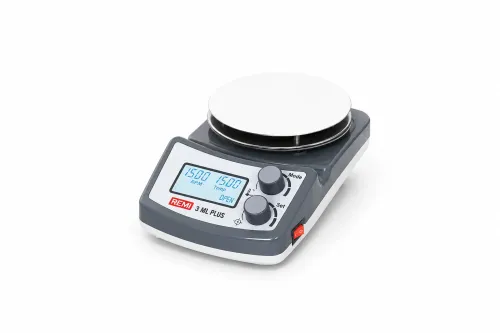
REMI Magnetic Stirrer 3L with LCD Display | Lab Mixing Equipment Supplier Reliable sample preparation starts with consistent mixing. The REMI 3 ML Plus Digital Magnetic Stirrer is designed for laboratory applications where precise and dependable stirring is essential without adding unnecessary complexity. Whether preparing analytical solutions, dissolving reagents, or mixing laboratory formulations, this instrument delivers smooth, stable, and repeatable stirring for routine laboratory operations. Its intuitive digital controls and easy-to-read LCD display allow laboratory professionals to accurately monitor and adjust the stirring speed according to specific application requirements. The compact design makes it an excellent choice for laboratories with limited bench space while maintaining professional-grade performance and reliability. Why Laboratories Choose the REMI 3 ML Plus Even small variations during sample preparation can influence analytical results in research and quality control. The REMI 3 ML Plus is engineered to provide consistent mixing throughout the entire process, helping researchers achieve reliable and reproducible results from one experiment to the next. The electronically controlled motor maintains stable stirring performance even when liquid viscosity changes, making it ideal for routine laboratory procedures that demand dependable and accurate operation. Ideal Applications The REMI 3 ML Plus Digital Magnetic Stirrer is suitable for a wide range of laboratory environments, including: Pharmaceutical Research Laboratories Chemical Testing Laboratories Biotechnology Laboratories Microbiology Laboratories University Research Centers Food Quality Testing Laboratories Benefits for Research and Quality Control Selecting the right stirring equipment plays an important role in improving laboratory efficiency and ensuring consistent experimental outcomes. The REMI 3 ML Plus offers several practical advantages, including: Reproducible sample preparation Precise digital speed regulation Uniform and consistent solution mixing Quiet and vibration-free operation Low maintenance requirements Improved batch-to-batch reproducibility Why Purchase Laboratory Equipment from Ernest Vision? Ernest Vision supplies high-quality laboratory equipment for pharmaceutical research, industrial testing, research institutions, quality control laboratories, and educational organizations. We are committed to providing reliable laboratory instruments backed by professional customer support and complete documentation to meet the needs of both domestic and international customers. With a strong focus on quality, performance, and customer satisfaction, Ernest Vision delivers dependable laboratory solutions that help researchers and professionals perform their work with confidence. REMI 3 ML Plus Digital Magnetic Stirrer 3L Laboratory Magnetic Stirrer Digital Magnetic Stirrer Magnetic Stirrer with LCD Display Lab Mixing Equipment Scientific Laboratory Equipment Magnetic Stirrer Supplier Laboratory Equipment Exporter Pharmaceutical Laboratory Equipment Contact Ernest Vision A Group Company of Ernest Pharmaceutical Pvt. Ltd. Official Websites 🌐 www.ernestvision.com 🌐 www.ernestpharmaceuticals.com 🌐 www.ernestimpex.com 🌐 www.oncologymedicinesupplier.com Corporate Email 📧 exports@ernestpharmaceuticals.com WhatsApp 📱 +91 94054 76170 Chat with Us on WhatsApp 💬 https://wa.me/message/V2MEXZ6ZAYY5B1

Dubai, United Arab Emirates
+919405476170
+919405476170
 Chat with us
 Chat with us